


Buying a home in Bergen County, New Jersey, offers access to established neighborhoods, convenient transportation to New York City, and a wide range of housing options. But before making an offer, buyers need to understand how property taxes affect long-term affordability.
The Bergen County property tax 2026 landscape varies considerably by municipality, property value, and local tax obligations.
Knowing how assessments work, comparing town-level rates, and accounting for potential tax relief can help you choose a home that fits both your lifestyle and your budget.
The Basics of the Bergen County Property Tax 2026 Landscape
The average Bergen County property tax 2026 effective rate is approximately 1.61%, which is significantly lower than the overall New Jersey state average of 2.23%. On a median home value of $623,000, homeowners in Bergen County can expect to pay roughly $10,001 annually in property taxes.

Breaking Down the Bergen County Property Tax Rate
How the Effective Rate Works
The Bergen County property tax rate can refer to either a municipality’s general tax rate or its effective tax rate. These figures are related but not interchangeable.
The general tax rate is applied to a property’s assessed value. The effective tax rate expresses the tax burden as a percentage of estimated market value, making it more useful when comparing communities where assessments may reflect different proportions of current market prices.
For example, if a home has an assessed value of $500,000 and the applicable general tax rate is 2%, its estimated annual property tax would be $10,000. That equals approximately $833 per month.
This calculation is illustrative. Your actual bill depends on the property’s official assessment and the tax rate adopted for its municipality and applicable taxing districts.
Understanding Equalization Ratios
New Jersey uses equalization ratios to help compare assessed property values with estimated true market values. These ratios are especially important when a municipality has not recently completed a comprehensive revaluation.
Suppose a town’s equalization ratio is 85%. That generally means its assessments average approximately 85% of market value. A home worth $600,000 might therefore have an estimated assessed value of $510,000, although the property’s actual assessment could differ.
The ratio is a valuation tool, not a separate tax rate. It helps buyers understand how assessments relate to market values and why comparing general tax rates alone can be misleading.
When researching the Bergen County NJ property tax rate, check the municipality’s current assessment information and the applicable state or county equalization tables. Official figures are more reliable than broad estimates found in older property listings.
Exploring Bergen County Property Tax Rates by Town 2026
Why Location Matters
Bergen County includes 70 municipalities, each with its own combination of municipal expenses, school funding requirements, and property assessments. Consequently, the Bergen County property tax rates by town 2026 can differ substantially.
Hackensack offers an urban setting with a range of housing types and municipal services. Mahwah provides a more spacious suburban environment with access to parks and natural areas. Ridgewood attracts buyers seeking a walkable downtown and established residential neighborhoods.
However, a lower effective tax rate does not automatically mean a lower tax bill. A more expensive home in a lower-rate municipality could still cost more in annual taxes than a less expensive home in a higher-rate community.
The Impact on Your Monthly Payment
Property taxes are an important part of your monthly housing expenses, alongside mortgage principal and interest, homeowners insurance, and any applicable association fees.
Consider a $600,000 home for comparison:
- At a 2.5% effective rate, annual taxes would be approximately $15,000, or $1,250 per month.
- At a 1.5% effective rate, annual taxes would be approximately $9,000, or $750 per month.
That difference amounts to $500 per month, or $6,000 annually. These examples illustrate the impact of different effective rates; they are not verified rates for specific Bergen County municipalities.
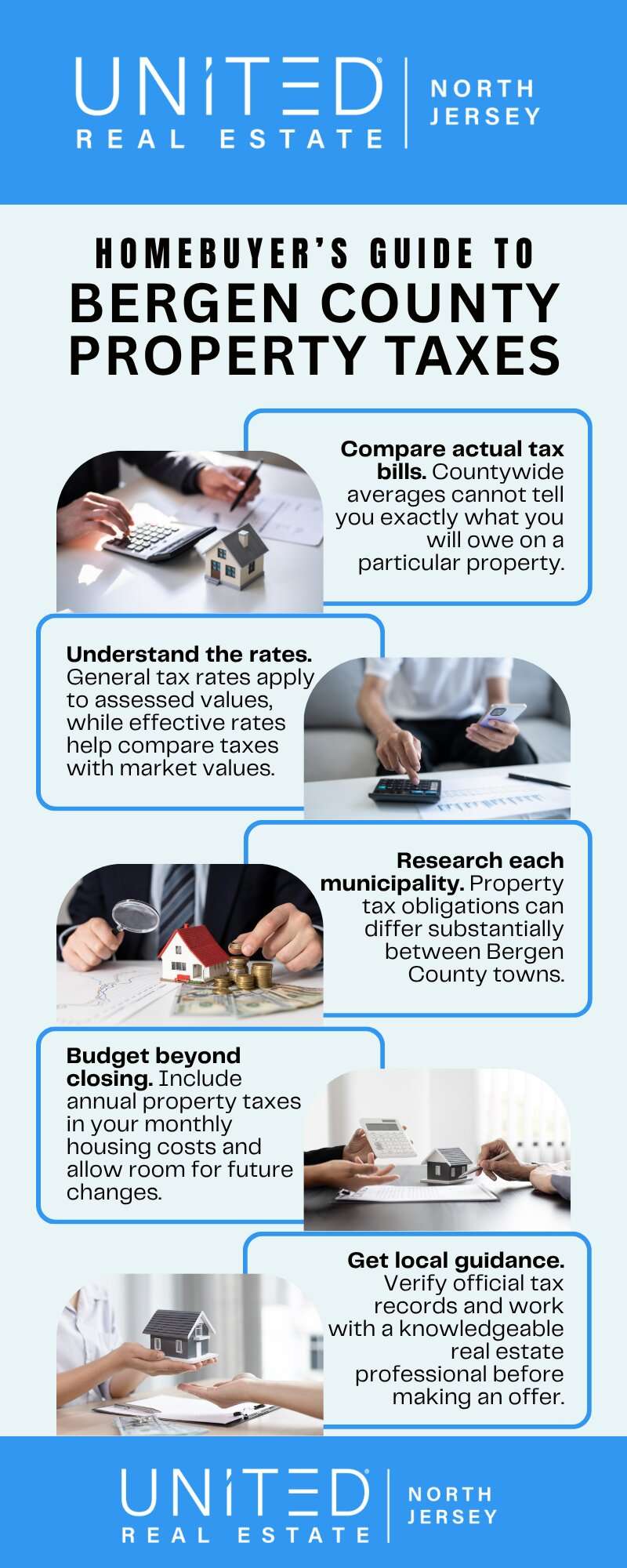
For buyers evaluating Bergen County homebuyer costs, the lesson is straightforward: compare the likely tax bill for each property, not just the listing price or advertised tax rate.

Navigating Assessments and Relief Programs
The Revaluation Process
A municipal revaluation updates property assessments to reflect current market values more accurately. If your target town conducts a revaluation in 2026, your assessment may rise even if you have not renovated or expanded the property.
However, a higher assessment does not automatically mean a proportionally higher tax bill. When assessments are updated across a municipality, tax rates may be adjusted to reflect the new total assessed value and the amount of revenue local taxing districts need to collect.
Individual bills can still increase or decrease depending on how a property’s value changes relative to other properties and local budgets.Before purchasing, ask whether the municipality has completed or scheduled a revaluation, and check how the proposed assessment compares with recent sales.
State Relief Programs
New Jersey offers several property tax relief programs, including ANCHOR, Senior Freeze, and Stay NJ. Eligibility varies by program and can depend on age, income, residency, disability status, and other requirements.
For the 2025 benefit year, New Jersey’s ANCHOR program provides eligible homeowners with benefits based on income and age. Homeowners with qualifying income of $150,000 or less may receive $1,500, while those with income between $150,001 and $250,000 may receive $1,000. Additional provisions may apply to eligible seniors.
Program rules, application deadlines, and benefit amounts can change. Prospective buyers should consult the New Jersey Division of Taxation to confirm current requirements rather than assuming a rebate will cover part of their future property tax bill.

Next Steps for Prospective Buyers
Utilizing a Bergen County Tax Guide
When you find a home you like, look beyond the property tax figure shown in the listing. That amount reflects an existing assessment and tax year, and your future bill may differ.
Use this checklist to evaluate the property’s tax obligations:
- Verify the current tax bill: Request the latest municipal tax record and confirm the amount with the local tax office.
- Check the assessment: Compare the assessed value with recent comparable sales and investigate any pending assessment changes.
- Review the applicable tax rate: Confirm the latest general and effective rates for the specific municipality.
- Calculate monthly costs: Divide the estimated annual tax by 12 and include it in your projected mortgage payment.
- Allow room for increases: Consider potential changes in school budgets, municipal spending, assessments, and tax rates.
For official comparisons, New Jersey publishes general tax rates and effective tax rates, while Bergen County provides equalization tables. Use the latest available records when estimating your costs.
Partnering with a Local Expert
A knowledgeable local real estate agent can help you compare neighborhoods based on more than purchase price. They can identify differences in property taxes, explain how recent sales relate to assessments, and help you evaluate trade-offs between commute times, schools, housing styles, and overall affordability.
A mortgage lender can also estimate your monthly payment using the property’s projected taxes. Together, these professionals can help you avoid committing to a home that stretches your budget.
Bergen County Town Tax Comparison Table
The following table provides an illustrative comparison using the effective-rate estimates supplied for this guide. These figures are not verified 2026 municipal rates. The 2025 New Jersey tax-rate tables show that official effective rates can differ from broad estimates, so confirm the latest municipal data before relying on these numbers.
Rates and calculated taxes are illustrative estimates for comparison, not confirmed 2026 figures. Annual tax estimates equal $600,000 multiplied by the stated rate. Actual taxes depend on the property’s assessment and applicable municipal tax rates.
The table demonstrates how tax assumptions can change a buyer’s projected monthly expenses. Before comparing towns, replace these estimates with verified figures for the relevant tax year and individual properties.
Securing Your New Jersey Home
Planning to buy in Bergen County in 2026 means looking beyond the asking price, down payment, and mortgage interest rate. Property taxes can make a substantial difference in your long-term housing budget, and even neighboring communities may have different tax structures.
Use this Bergen County tax guide to compare actual tax bills, understand assessments, investigate potential revaluations, and check eligibility for state relief programs. The right decision balances affordability with the neighborhood, commute, amenities, and services that matter most to you.
If you’re ready to explore homes and compare property taxes across Bergen County, feel free to give me a call at (201) 450-0015 or email kriskehoerealestate@gmail.com.
Frequently Asked Questions
What is the average Bergen County property tax 2026 rate?
There is no single rate that applies to every Bergen County home. Effective rates vary by municipality and property, and the actual bill depends on the assessment and applicable tax rates. Check the latest official New Jersey tax tables for verified figures.
How do Bergen County property tax rates by town 2026 vary?
Rates differ because municipalities have different school funding needs, operating expenses, assessed property values, and tax structures. Compare the latest official effective rates alongside the actual annual tax bills for homes you are considering.
Is the Bergen County property tax rate higher than the rest of New Jersey?
New Jersey is known for its substantial property tax burden, but Bergen County should not automatically be described as cheaper than the state average without comparing figures from the same year and using the same methodology. Individual municipalities and homes can vary considerably.
What does a reliable Bergen County tax guide recommend for estimating future taxes?
Start with the property’s current tax bill and assessment. Confirm the latest municipal rate, check for planned revaluations, and ask your lender to estimate monthly escrow using a realistic tax projection. Do not assume the seller’s existing bill will remain unchanged.
How do New Jersey property taxes affect Bergen County homebuyer costs?
Property taxes increase the recurring cost of homeownership and are often collected monthly through a mortgage escrow account. A higher tax bill can reduce the mortgage payment a buyer can comfortably afford, even when two homes have similar prices.
Will a town revaluation increase my Bergen County, NJ property tax rate?
Not necessarily. A revaluation updates assessed values to better reflect market conditions, and tax rates may adjust afterward. Your individual bill can rise or fall depending on how your property’s new assessment compares with other properties and changes in local tax requirements.
Are there any tax relief programs when buying a home in Bergen County?
Eligible New Jersey homeowners may qualify for programs such as ANCHOR, Senior Freeze, or Stay NJ. Each has its own eligibility rules and application requirements. Check the New Jersey Division of Taxation for current details before including potential benefits in your budget.